Nature Trails

Family-Friendly Lagoon Trails: Stroller and Short-Walk Routes Compared
On a map, almost every lagoon walk looks the same: a thin line hugging the water, no hills, no climbs. Then you arrive with a stroller and find that flat is not the same as easy. A crushed-stone embankment can swallow small wheels, a boardwalk can rattle a sleeping baby awake, and a paved waterfront can be so exposed at noon that nobody enjoys it. What follows compares routes by what they actually feel like underfoot, with notes on distance, shade and the places where a pram stops being an asset.
Start with the surface, not the distance
Distance is the number everyone checks first, and it is the least useful one. Two kilometres of gravel bank will tire out an adult pushing a pram far more than four kilometres of level pavement, because the effort goes into your wrists and shoulders rather than your legs. Small hard plastic wheels catch in loose stones and send every bump upward. Larger air-filled tyres roll over most of it, but they add weight on the stretches where you end up carrying both the child and the pram.
Before committing to a route, ask three questions. How wide is the path when two people meet? What is underfoot for the whole length, not just the first hundred metres? And does the path narrow anywhere into a step, a gate or a raised edge? Those answers decide more about your morning than the kilometre count does.
Four surfaces, compared
Most lagoon walks fall into one of four categories, and each suits a different kind of family outing.
- Paved waterfront promenades. Smooth and predictable, usually with a low wall or railing on the water side and benches at intervals. Best for prams with small wheels, scooters and balance bikes. Watch the midday sun: paving reflects heat and there is often nowhere to hide.
- Gravel and crushed-stone embankments. The classic lagoon walk, running along the top of a levee between water and fields. Quiet, wide, excellent for spotting birds. Loose stones are hard on small wheels; air tyres cope, a lightweight umbrella stroller does not. Check for muddy patches after rain.
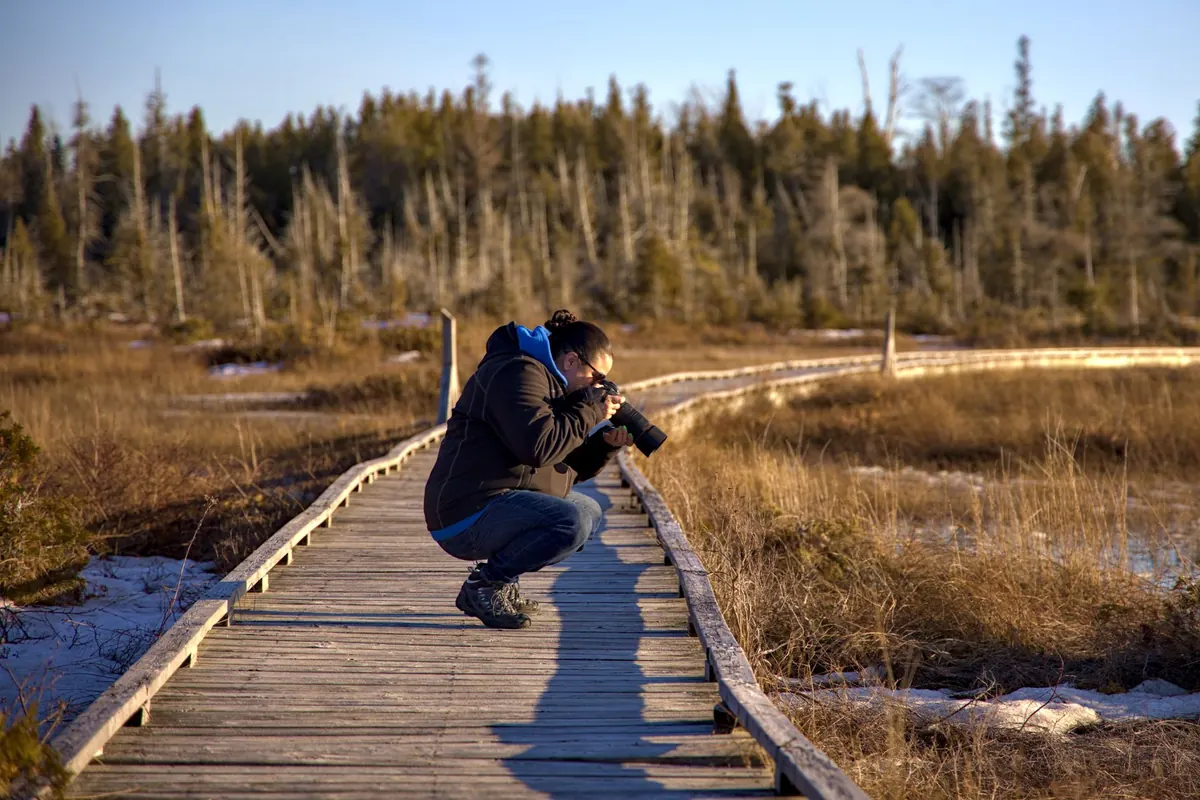
- Wooden boardwalks and duckboards. Flat and firm, often raised over reeds or wet ground, with rails on one or both sides. Ideal for toddlers who need containment. The gaps between planks are the catch, since small wheels drop in, and the surface turns slick when wet.
- Grass and mown field edges. Soft, partly shaded, forgiving for crawlers and new walkers. Not a pram surface at all unless the ground is dry and the grass short. Fine as a short detour, tiring as a route.
A good family route often mixes two of these: pavement to reach the water, gravel or boardwalk for the pleasant middle, pavement again at the end. Mixed surfaces are worth it when the rough section is short and you know exactly where it starts.
Distances, turning points and the half-way rule
Out-and-back routes beat loops for families with young children, for one simple reason: you can shorten them at any point without a map, a bus or a change of plan. Set a visible landmark as the goal, whether that is a small bridge, a bench or the second line of mooring posts, and treat it as optional.
The half-way rule saves a lot of misery. Turn around while the children are still happy, not when they are tired. Whatever energy is left at the turnaround is roughly what you will need for the return, plus a margin, because the last stretch always feels longer. For most families with a three- to five-year-old, one and a half to three kilometres of easy surface makes a comfortable morning with plenty of stopping.
Note your turnaround point clearly on the way out. Lagoon paths look remarkably similar in both directions, and "just a bit further" is how a short walk becomes a long carry.
Shade, wind and the middle of the day
Lagoon paths are exposed. Water on one side and open fields on the other means the sun reaches you from mid-morning until late afternoon, and there is often no tree line to break it. Shade, where it exists, tends to come from three places: rows of poplars or willows along field boundaries, tall reed beds on the landward side, and the walls and narrow lanes of villages at either end of a route.
Wind matters as much as sun. A breeze off the water makes a hot day pleasant, but it also strips hats and pushes a pram along more than you expect. Light layers, a hat with a chin strap and a muslin over the pram handle are worth the small extra weight. Early morning is the calmest, coolest window, and it is also when the lagoon is busiest with birds.
Bridges, gates and other stroller traps
The obstacles that ruin an otherwise easy walk are rarely dramatic. They are small, and they appear without warning. Canal footbridges are the most common: many have steps, sometimes three or four, sometimes a full flight with a landing. A light pram can be lifted by two adults; a heavy one cannot, and a solo parent with a toddler in tow should assume every stepped bridge means unloading and carrying. Where a route crosses several bridges, check whether an alternative along the same waterfront avoids them.
Then come the smaller annoyances. Kissing gates and narrow pedestrian barriers that a pram will not fit through. Bollards spaced for cars rather than pushchairs. Chains across slipways, and short flights of stone steps down to a water-level path. Tide-washed stone near the water is often slick with algae, which is fine in trainers and treacherous under smooth wheels.
Access points tell you who a path was built for. Routes beginning at a village car park or a bus stop are usually the ones maintained for pushchairs and wheelchairs; routes reached only by a rough track or a stile are not.
Water edges and small children
Lagoon water is shallow, which is exactly what makes it a concern. A child can be out of reach in seconds on an unfenced bank, and the drop from an embankment top to the water is often more than it looks. Choose routes with a grass verge or a railing between path and edge where you can, and hold hands on narrow sections without negotiating about it.
Keep the adult-to-child ratio generous near water, and put the faster child on the landward side. If your toddler is a runner, a railed boardwalk is a better choice than a wide open levee, even if it is shorter.
Plan the morning in five minutes
- Pick the surface first: pavement or boardwalk for small wheels, gravel only with air tyres.
- Choose an out-and-back route with an obvious landmark at the far end.
- Set the turnaround at roughly half your child's usual walking energy, not half the distance.
- Check the forecast for wind as well as temperature, and pack hats with chin straps.
- Scan the map for stepped bridges and narrow gates along your chosen stretch.
- Take more water than you think you need, and a snack for the walk back.
The best lagoon walk with young children is rarely the most scenic one. It is the one where nobody has to be carried, the wheels keep turning, and there is time left at the end for a second ice cream.
Photo: PNW Production / Pexels
Related Articles